ONBOARDING GAMIFIED

Week one is an information dump. The handbook, the systems, the acronyms, a calendar full of intros. Confidence is what's missing. We build onboarding as a game new hires play through your actual workflows, so they arrive at the real desk having already done the job in miniature.

Systems Training Brand Standards Seasonal Surge Contractor Onboarding First 90 Days

Day one isn't the problem. Day forty is.

Most onboarding frontloads everything into a week the new hire barely remembers. Then the support disappears, and the real learning happens the slow way: by asking, guessing, and making the mistakes the program was supposed to prevent.

The cost shows up later as time-to-productivity nobody measures and early quits everybody does. People rarely leave because the job was hard. They leave because they were confused, unconfident, and convinced it wasn't going to get better.

Ramp speed is a design choice.

The SHRM Foundation's research report on onboarding, written by Portland State's Talya Bauer, puts it plainly:

"Onboarding helps new hires adjust to the social and performance aspects of their jobs so they can quickly become productive, contributing members of the organization."

Talya Bauer, SHRM Foundation: Onboarding New Employees, Maximizing Success

The same report describes what redesign buys you: when Texas Instruments improved its onboarding program, new employees reached full productivity two months faster than peers who went through the traditional one. Two months of output, recovered by changing how the first weeks work.

Learn the job by playing it.

Our onboarding games put new hires inside simulated versions of your systems and situations. The POS, the booking screen, the customer conversation, the escalation that goes wrong. They make the beginner mistakes in the game, where mistakes are the point, and show up to the real shift past them.

Information Dump Guided Reps
Shadow a Veteran Drive the Sim
Ready in Months Confident in Days

Every industry ramps differently.

These are the onboarding problems already mapped across our industry pages, from seasonal surges to contractor inductions.

Retail: the Seasonal Surge

Hundreds of seasonal associates, weeks before peak, no time for shadowing. Game-based onboarding compresses register, floor, and loss-prevention basics into reps a new hire can run before the first shift.

Seasonal onboarding for retail →

Hospitality: Brand Standards

The difference between a hotel and the brand promise is a hundred small standards. New staff learn them by living a simulated guest journey, from check-in to the complaint that becomes a recovery story.

Brand-standards onboarding for hotels →

Oil & Gas: Contractor Induction

Most of the frontline workforce is contractors, inducted fast and unevenly. Scenario-based induction drills site rules and stop-work judgment before anyone walks through the gate.

Contractor onboarding for oil & gas →

Logistics: Peak Warehouse Ramp

Peak season hires thousands into the most injury-prone major sector. Dock, picking, and forklift-awareness basics become games new starters finish before they're near the racking.

Peak onboarding for warehouses →

Real Estate: the New-Agent Ramp

Most agents quit within five years, and the ramp is where it's decided. Game-based onboarding gives new agents reps on the conversations that fund the career, listing presentations, buyer consults, the first negotiation, before they burn real leads learning them.

New-agent onboarding for brokerages →

Systems training, playable now.

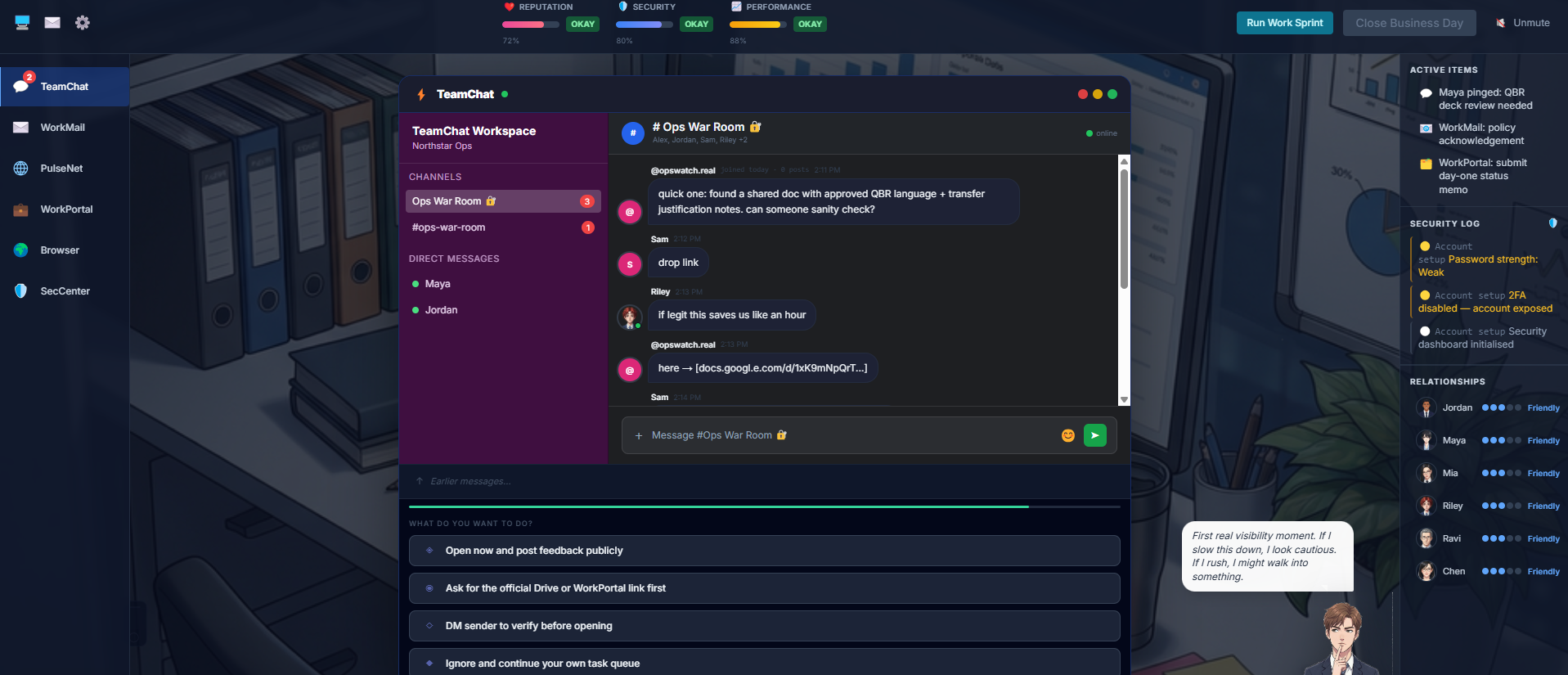
One Click Away, a chat workspace under pressure during onboarding GU-01 · ONE CLICK AWAY
Narrative Decision Game · New-Hire Onboarding

One Click Away

You play a new hire in your first week: real inbox, real chat pings, real pressure to just click the link and keep up. One skipped MFA prompt, one "just this once" password share, and the consequences snowball into a full breach. It's onboarding and security awareness in one playthrough, and the lesson lands because you lived it, not because slide 14 said so.

First-week onboarding · Security awareness · Systems-in-simulation

Play One Click Away

One Click Away teaches systems by simulating them, which is the whole onboarding thesis in one demo: put the new hire inside a working copy of the job. The same approach builds your POS, your booking system, or your dispatch board.

Asked by every people team we meet.

How custom is custom?

The game is built around your company, not reskinned from a template. Your systems appear as working simulations, your policies drive the scenarios, and the characters talk like your customers actually talk. Discovery means sitting with your best performers and your newest hires to find the gap between them. That gap is the game design. Two companies in the same industry get visibly different builds because their first 90 days are different.

What does a 90-day onboarding arc look like in a game?

Week one is dense: guided scenarios that cover systems, layout, and the non-negotiables, played before or alongside the first shifts. Then the cadence spreads out. Weekly scenarios introduce harder judgment calls as real-world experience accumulates, and spaced refreshers return to early material right as it would otherwise fade. By day 90 the new hire has run the full range of situations the role produces, including the rare ones a quiet quarter would never have shown them.

How do refreshes work when our process changes?

Builds are versioned and content-driven, so a process change is usually a content update we turn around in days, not a rebuild. New SKUs, a new screen flow, or a policy change slot into the existing scenario structure. Larger changes, a new system or a new role, are scoped as expansions. Most clients keep a running backlog with us and batch updates quarterly.

Does it replace our LMS?

No. The game is content; your LMS stays the system of record. Builds ship as SCORM or xAPI packages that launch from the LMS and report completions and scores back into it, with SSO so nobody gets a second login. If you track onboarding in an HRIS checklist instead, the game slots in as a step there. Teams without either run the web build standalone.

What does maintenance involve?

After launch, a build needs the same care as any living training asset: content updates when your processes change, a periodic review of the scenarios against what new hires are actually struggling with, and platform updates we handle on our side. We agree on a support arrangement that fits how often your business changes, and the data tells us which scenarios are aging: when everyone starts acing a scenario that used to be hard, it's time to add depth.

From first day to full speed.

Four stages. Typically 8 to 16 weeks from first call to deployed onboarding, timed to land before your next hiring wave.

  1. 01

    Discover

    We map the real first 90 days with your managers, your best performers, and your newest hires, including where ramp actually stalls.

  2. 02

    Design

    Game designers co-create the scenario arc with your trainers and SMEs, and pilot with one location or one cohort first.

  3. 03

    Build

    Custom art, simulated systems, and scenarios crafted in-studio for the platforms your people actually use: mobile, web and LMS, or the back office.

  4. 04

    Deploy & Measure

    LMS and SSO integration, ramp data by cohort and location, and scenario updates as your processes evolve.

Productive in days, not months.

Book a 30-minute demo. We'll show you One Click Away, talk through your roles, your ramp, and where new hires actually stall, and sketch what a custom onboarding build or pilot looks like for your team. No pressure.

Or email braeden@gosuacademy.com directly.