SAFETY TRAINING SIMULATED

The procedure is signed. The question is what happens at 2 a.m. when the permit doesn't match the pipe. We build safety training as scenarios crews rehearse: the isolation check, the stop-work call, the load that shouldn't move. Drilled before it's real, on every site you run.

Permit to Work Energy Isolation Stop Work Ramp & De-Icing Forklift & Dock Emergency Response

Signed isn't safe.

OSHA wrote the case for rehearsal.

The agency's training handbook states the payoff plainly, and its own glossary defines the format. Both lines, word for word:

"Training in the safe way for workers to do their jobs well is an investment that will pay back over and over again in fewer injuries and illnesses, better morale, lower insurance premiums and more."

"'Hands-on training' means training in a simulated work environment that permits each student to have experience performing tasks, making decisions, or using equipment appropriate to the job assignment for which the training is being conducted."

OSHA, Training Requirements in OSHA Standards (OSHA 2254)

Performing tasks, making decisions, in a simulated work environment. That is the regulator's own definition of hands-on training, and it's exactly what a well-built simulation is. We just make the simulated environment your environment.

Drill the decision, not the paragraph.

We rebuild your procedures as scenarios with consequences. Crews face the situation, make the call, watch what follows, and run it again. The same drill, a dozen variations, until the safe response is the reflex.

Signed Acknowledgment Rehearsed Response
Annual Refresher Recurrent Drills
Read the Procedure Run the Scenario

Every site has its own worst moment.

These are the safety domains already mapped across our industry pages, each with the scenarios that drill it.

Oil & Gas

Permit-to-work, energy isolation, gas testing, and the stop-work call under schedule pressure. Built around control-of-work procedures and the incidents your HSE team already studies.

Safety simulations for oil & gas →

Aviation

Ramp and turnaround judgment, de-icing decisions, evacuation command, and dangerous goods acceptance. Mapped to the frameworks your operation is audited against.

Aviation safety simulations →

Logistics & Warehousing

Forklift and dock operations, pedestrian separation, load judgment, and DOT driver compliance. The sector with twice the all-industry injury rate is the one with the most to gain.

Forklift & dock safety drills →

Telecom Field Work

Work at height, RF exposure awareness, trenching, and the solo-tech judgment calls nobody supervises. Drilled before the truck rolls, not after the near miss.

Field safety training for telecom →

Hospitality & Life Safety

Fire response, evacuation roles, and the guest-facing emergencies hotel teams almost never get to practice. Scenario drills give night-shift staff the same readiness as the day team that did the live drill, on every property and every shift.

Life safety scenarios for hotels →

Two drills from the oil & gas floor.

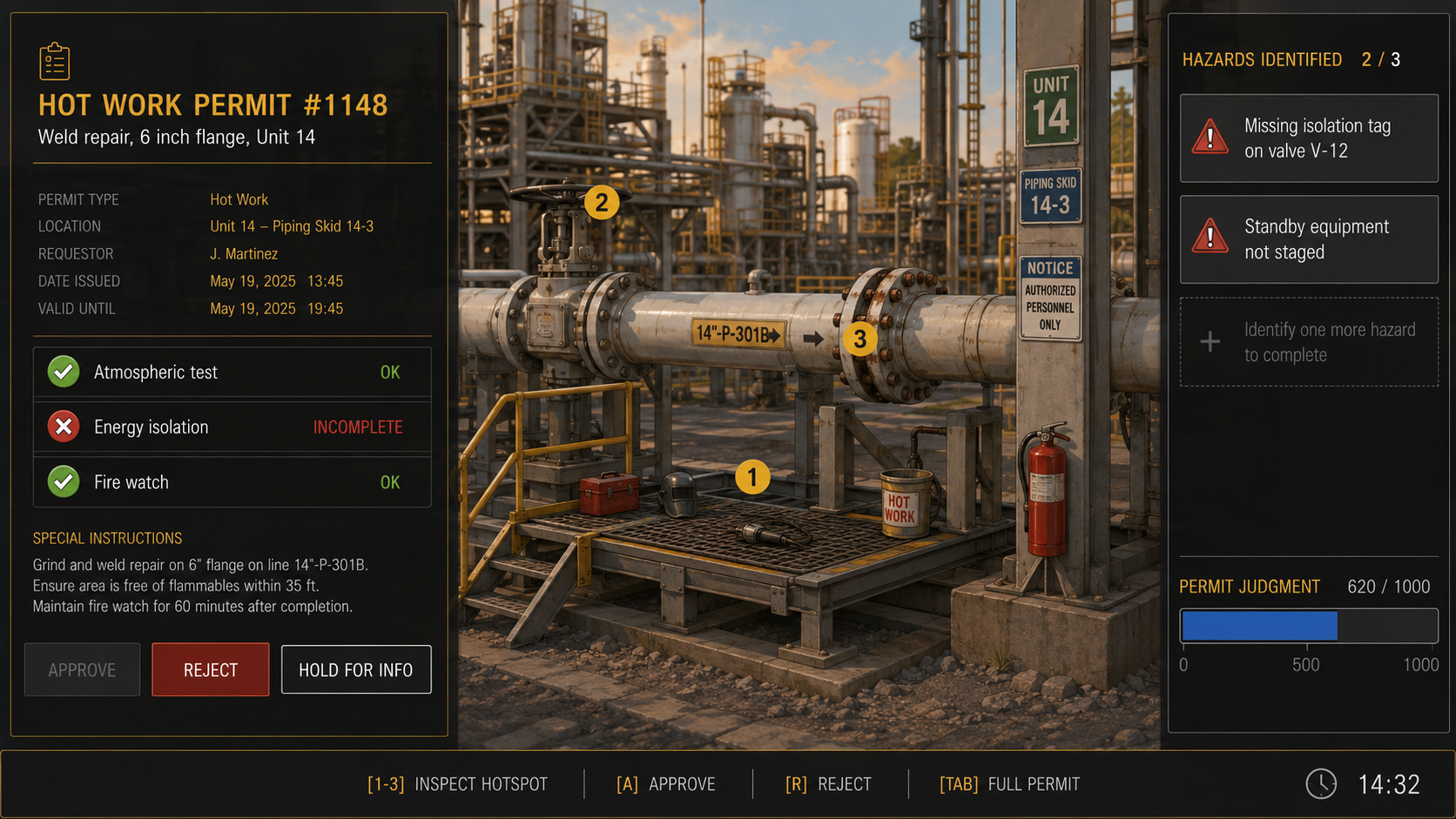
Permit Master, a permit-to-work document review simulation GU-OG · PERMIT MASTER
Document-Review Simulation · Control of Work

Permit Master

Players act as permit issuers, receivers, and area authorities, building work packs for hot work, confined space entry, and line-breaking. Hidden hazards have to be surfaced before approval, and missed isolations are scored against barrier integrity rather than speed. Inspired by the equipment-identification failure behind the 2024 Deer Park H2S release.

Permit issuers & receivers · Area authorities · Contractors

See It in a Demo
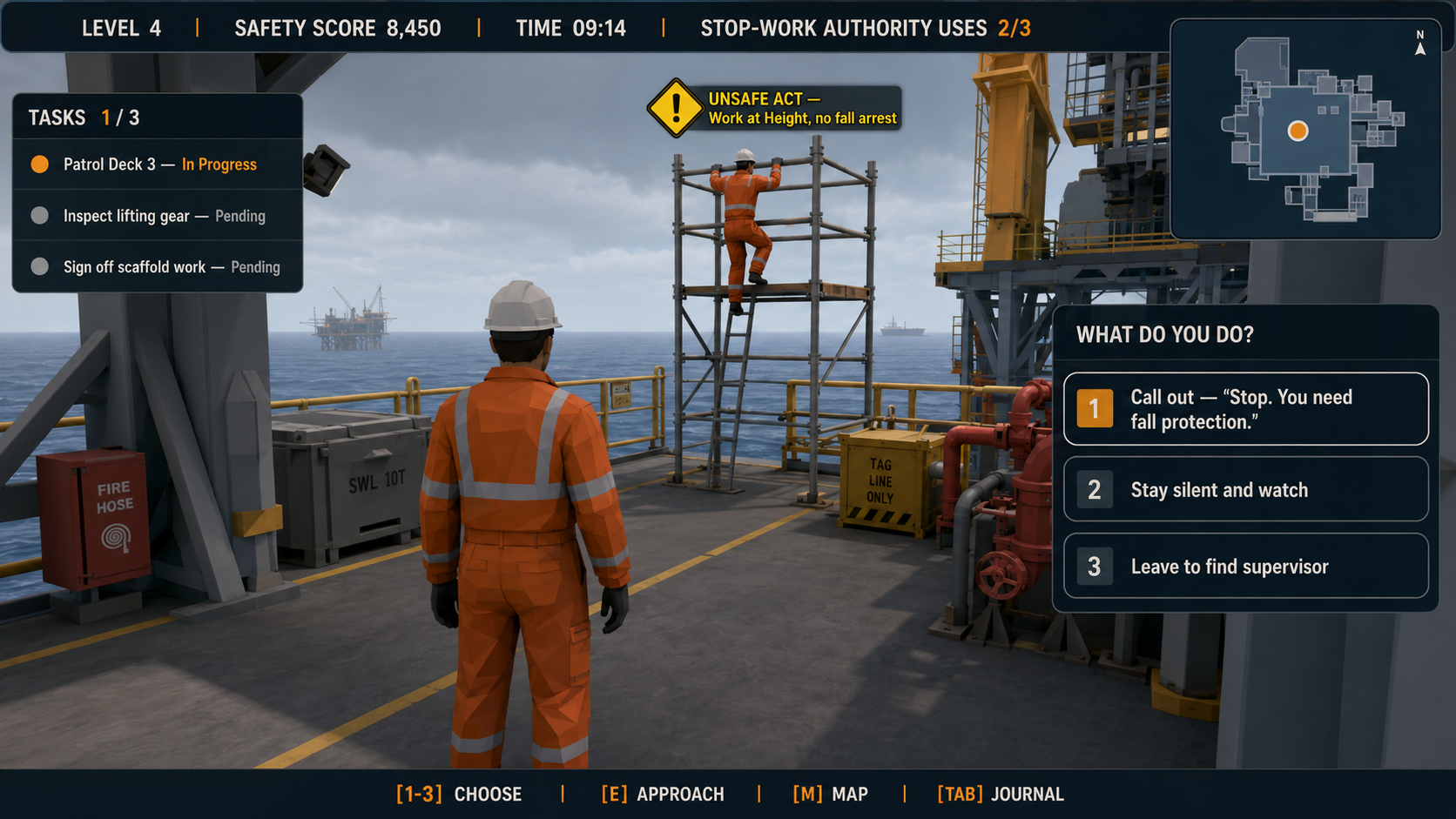
Stop Work Hero, a first-person stop-work-authority scenario drill GU-OG · STOP WORK HERO
First-Person Scenario Drill · Life-Saving Rules

Stop Work Hero

Built around the nine IOGP Life-Saving Rules: bypassing controls, working at height, line of fire, energy isolation, hot work, lifting, driving. Players face the dilemmas under social pressure from peers, supervisors, and customers, and scoring rewards the reasoning behind the call rather than the right answer alone. The instinct comes from drilling the same standoff dozens of ways.

Frontline crews · Supervisors · HSE leadership

See It in a Demo

Both concepts come from our oil & gas work, and the engine behind them is industry-agnostic. The same scenario structure drills ramp decisions for a ground handler, dock decisions for a 3PL, and evacuation command for a hotel chain.

Asked by every HSE team we meet.

Is simulation training accepted for compliance documentation?

Training records from our simulations document what regulators increasingly ask for: not just who attended, but who demonstrated the skill. OSHA's own training guidance defines hands-on training as practice in a simulated work environment, and our builds log every decision a worker makes in a scenario. Where a standard requires specific elements, live practical evaluation or equipment time, the simulation complements those rather than replacing them, and we map content to the standard with your HSE team so the documentation holds up.

Can scenarios mirror our actual sites?

Yes, and they should. Discovery includes site walks, your procedures, your permit forms, and your incident history. Scenarios reproduce the unit, the dock layout, or the ramp stand your people actually work, with your terminology and your paperwork. Crews stop playing a generic warehouse and start recognizing their own Tuesday. That recognition is what makes the drill transfer to the job.

How do you handle multilingual crews?

Builds ship with full localization: interface, scenario dialogue, and debrief content in the languages your workforce actually speaks, not just the official one. Audio voiceover covers crews who read slowly in any language. For Gulf operations we routinely pair English with Arabic, Hindi, and Urdu. Language switching is per-player, so one cohort can drill the same scenario in four languages and the scoring stays comparable.

What does measurement look like?

Every scenario decision is logged, so you see the leading indicators a sign-in sheet can't show: who hesitates on stop-work calls, which crews keep missing the same isolation step, and how response quality changes across attempts. Reports break out by site, crew, and contractor company. Several customers feed the data into their existing HSE dashboards next to observation and near-miss numbers.

How fast can a drill scenario ship?

A focused single-scenario drill, one procedure, one decision chain, can pilot in roughly six to eight weeks. Full multi-module builds run 8 to 16 weeks depending on scope and platforms. Most HSE teams start with the highest-severity procedure on their risk register, run a pilot cohort, and expand from the data.

From procedure to practice.

Four stages. Typically 8 to 16 weeks from first call to deployed simulation, and your HSE team signs off on every scenario before it reaches a crew.

  1. 01

    Discover

    Site walks with your HSE and operations teams to map the procedures, the pressure points, and the incidents that actually happened.

  2. 02

    Design

    Scenario designers co-create the drills with your supervisors and SMEs, and pilot with one site or one crew before any wider rollout.

  3. 03

    Build

    Custom environments, scenarios, and scoring crafted in-studio for the platforms you need: VR, mobile, web and LMS, or the toolbox talk.

  4. 04

    Deploy & Measure

    LMS and SSO integration, leading-indicator data your safety review can act on, and scenario updates as procedures change.

Rehearsed before it's real.

Book a 30-minute demo. We'll show you real safety simulations, talk through your sites, your procedures, and the incidents that shaped them, and sketch what a custom drill or pilot looks like for your operation. No pressure.

Or email braeden@gosuacademy.com directly.